


The Border Disappeared
Brussels | May 22, 2045
For centuries, borders were lines drawn on maps. They separated nations, laws, taxes, and identities. But this morning, the European Security Network announced that physical borders would no longer determine where national authority begins or ends.
The change followed the launch of BORDERLESS, an AI system that tracks people, money, data, and legal obligations across countries in real time. Instead of asking where a person is, the system determines which government has authority over each action.
A French citizen working in Germany, buying from a Korean company, and storing data in Canada may now exist under several jurisdictions simultaneously. BORDERLESS decides which laws apply within milliseconds, without passports, checkpoints, or court petitions.
Supporters called it the end of geographic bureaucracy. Trade moves faster. Criminal investigations no longer stop at national boundaries. Refugees can establish digital identities before reaching a physical checkpoint. Governments say the system makes borders less important while making enforcement more precise.
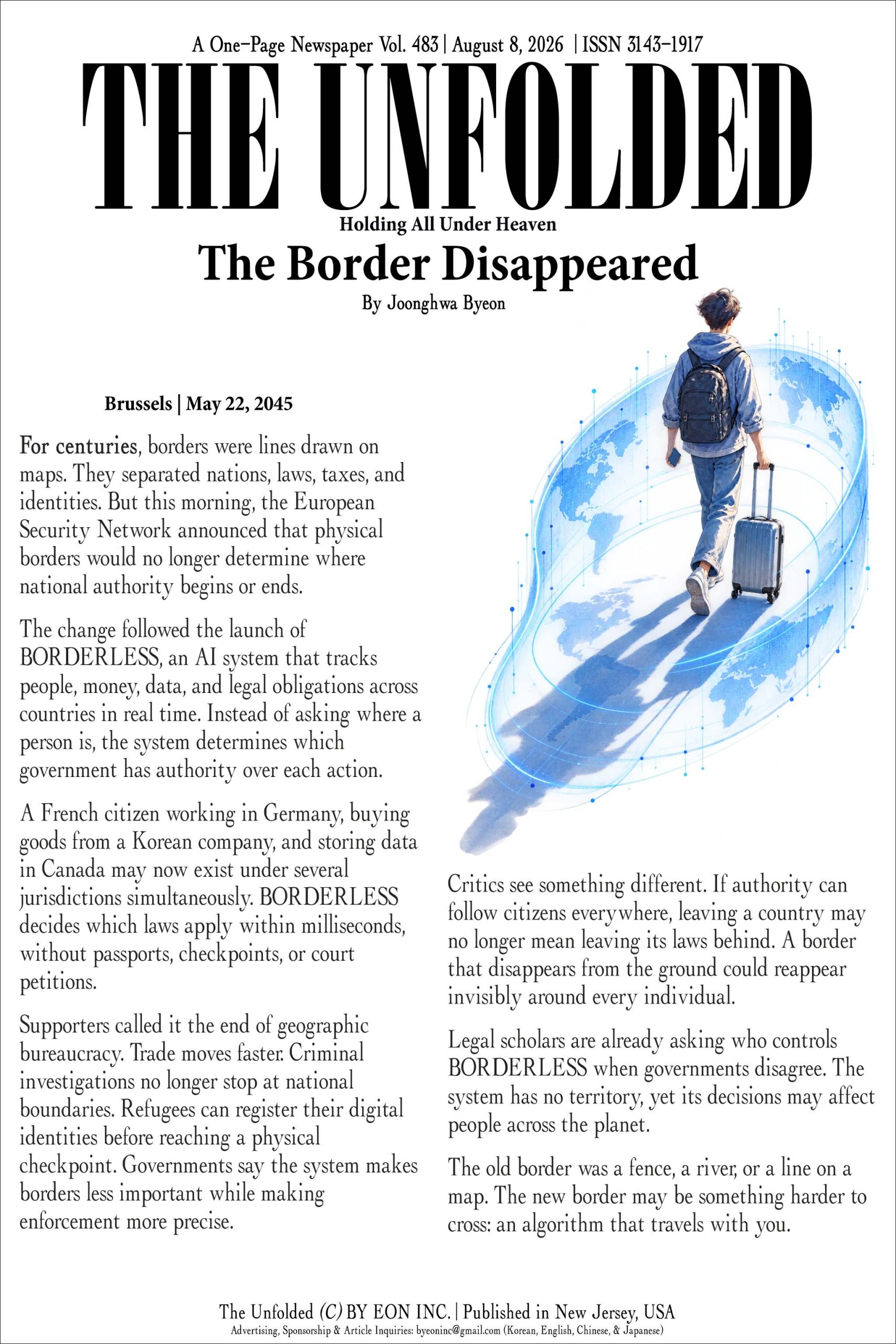
Critics see something different. If authority can follow citizens everywhere, leaving a country may no longer mean leaving its laws behind. A border that disappears from the ground could reappear invisibly around every individual.
Legal scholars are already asking who controls BORDERLESS when governments disagree. The system has no territory, yet its decisions may affect people across the planet.
The old border was a fence, a river, or a line on a map. The new border may be something harder to cross: an algorithm that travels with you.
— Joonghwa Byeon


